Alright, let’s dive into something that you’ve probably seen a million times but never really thought about: those tall, spindly towers with wires stretching out like giant spider legs holding them up. Yeah, I’m talking about guyed wire towers. As someone who’s been in the game supplying these things for over a decade, I get way too many people asking, “What even is the point of those?” Instead of just saying “they hold stuff up,” let’s break this down like we’re hanging out over a coffee (or a beer, no judgment—depending on the time). Guyed Wire Tower
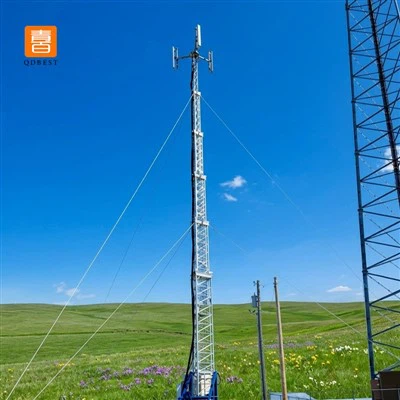
First off, let’s get one thing straight: guyed towers are not your average self-supporting cell tower or power line tower. You know the ones I mean—those big, solid steel frames that look like they could survive a hurricane and a zombie apocalypse at the same time? Guyed towers are the leaner, meaner cousins, but their purpose is way more specific than just “being tall.” Let’s start with the basics: a guyed wire tower uses those tensioned steel guy wires (or guys, as we call ’em) anchored into the ground to stabilize a tall, narrow mast. No huge base, no massive foundation—just a mast, some wires, and a few concrete or steel anchors buried deep.
Now, why would anyone choose that over a self-supporting tower? The short answer: it’s all about height, cost, and simplicity. If you need to go really high—like, 100 feet, 200 feet, even up to 500 feet or more—without dropping a fortune on a giant base, guyed is the way to go. Think about it: a self-supporting tower’s base gets way wider as it gets taller, which means more steel, more concrete, more labor. Guyed towers? Their base is tiny—sometimes just a 10×10 foot footprint—because the guys do all the heavy lifting (literally). That’s a huge win for folks working on tight budgets or in spots where space is at a premium. Like, if you’re putting a cell tower on a small town’s water tower, or a communications tower on a ridge where you don’t want to tear up half the land, a guyed tower fits like a glove.
But let’s get into the actual purposes beyond just “staying up.” Because yeah, stability is key, but what are they actually holding? Let’s run through the big ones you’ll see every day. First up: cellular and wireless communications. You know when you’re driving down a backroad and your bars jump from 1 to 4 suddenly? That’s probably a guyed tower. Small telecom providers, rural internet companies, even some small cell carriers use these because they can put up a tall mast for antennas without breaking the bank. The guys keep it steady when that gusty mountain wind hits, so your zoom call doesn’t cut out mid-hike. I’ve got a buddy who runs a rural internet co-op in Ohio—he swears by guyed towers because he can put up a 180-footer for half the cost of a self-supporting one, and the coverage area is massive enough to serve 3,000 households. No joke, those towers changed his county.
Next, broadcast and media stuff. TV and radio stations need antennas up high to reach listeners and viewers, right? A lot of smaller FM stations or low-power TV stations use guyed towers because they don’t have the budget for a full broadcast center’s self-supporting tower. Plus, if you’re a college radio station or a local community TV outlet, you don’t need that giant, eye-sore structure in the middle of town—most guyed masts are pretty sleek, and if you hide the antennas with radomes (those white, bulbous covers), they blend in way better than a chunk of steel that’s the size of a house. I worked with a public radio station in Maine a few years back—they put a 220-foot guyed tower on a hill outside of Portland, and their signal now reaches all the way up to Bar Harbor. That’s the power of height, and guyed towers make that height affordable.
Then there’s power and energy—wait, not just the big high-voltage lines, but smaller-scale stuff like distributed energy, smart grid sensors, and even solar or wind farm monitoring. Wind farms are usually out in open, flat areas, and putting up a tall mast to measure wind speed (that’s an anemometer, for the non-wonk folks) or to connect to a small grid substation? Guyed towers are perfect here. They’re quick to install—we can have a 300-footer up in a week, start to finish, whereas a self-supporting tower would take 3 weeks minimum. And in wind farms, time is money—you want those sensors up and running so you can tune the turbines and start making cash faster. Also, for remote oil and gas sites, they use guyed towers for pipeline monitoring equipment or satellite communication links—no need for a huge base when you’re in the middle of nowhere, and the guys can handle the wind out on the plains or in the desert.
Oh, and let’s not forget emergency communications. When a hurricane knocks out cell towers, or a wildfire takes down infrastructure, those portable or temporary guyed towers are a lifesaver. We supply a lot of these to FEMA and local emergency response teams—they’re lightweight, can be assembled in hours, and when the crisis is over, you can take ’em down and move ’em to the next spot. No concrete to pour, no permanent construction—just bolt the anchors to existing pavement or even temporary ground anchors, and you’ve got a tower that can hold comms gear for days or weeks. I saw a video from last year’s Maui wildfires where a guyed tower we’d supplied was set up in a parking lot, keeping first responders connected when every other tower was out. That’s when you realize these things aren’t just business—they matter for real people.
Wait, but let’s get into the science part, because it’s not just “put wires on the side.” The purpose of those guy wires isn’t just to hold the mast up—it’s to resist all the forces that would knock it over. Wind is the big one: when wind hits a tower, it creates a sideways force, and the taller the tower, the bigger that force. The guy wires are tensioned at specific angles—usually 3 to 6 sets of guys, spaced evenly around the mast—to pull against that wind load. Also, weather stuff like ice and snow adds weight, which can pull the mast off-center, so the guys have to be tensioned just right to keep everything straight. We do load calculations for every tower we supply—we figure out the local wind speed, the weight of the antennas, the ice potential, and then spec the right steel for the mast and the right diameter for the guys. It’s not just guessing; it’s engineering that makes sure the tower stays up for 20, 30 years, even in the worst weather.
Another thing: flexibility. Guyed towers can sway a little—they’re not rigid like self-supporting towers, and that’s a good thing. When wind hits, a rigid tower would absorb all the force, which could crack the foundation or bend the steel. A guyed tower sways, the tension in the guys absorbs the wind energy, so the whole structure is less likely to fail. That’s why you see them out on coastlines or in mountainous areas—they move with the wind, not against it. I’ve had customers in Florida tell me their guyed towers withstood hurricanes that took down trees and power lines nearby—because the flex kept them intact.
Now, let’s talk about the myths I hear all the time. First, “guyed towers are less stable.” No, that’s only if they’re installed wrong. When done right, they’re just as stable as self-supporting towers, especially for heights over 150 feet. Second, “they’re ugly.” Yeah, if you put a bunch of random guys on a house, that’s ugly. But when you space them properly, use high-tensile steel guys that are galvanized (so they don’t rust), and maybe add insulators so they don’t look like a big wire mess, they’re way less obtrusive than a self-supporting tower. Plus, a lot of modern guyed masts are made of aluminum or even composite materials, so they’re sleek and low-profile.
So putting it all together, the core purposes of a guyed wire tower are: 1) to get to height affordably without a huge footprint, 2) to stabilize tall masts against wind, ice, and other forces using tensioned guy wires, 3) to support communications, broadcast, energy, and emergency gear in spaces where bigger towers don’t make sense, and 4) to be quick to install and flexible enough to survive tough conditions.
Here’s the thing: I don’t just supply these towers because it’s my job. I supply them because they solve real problems that other structures can’t. If you’re a telecom company needing to cover a rural area, a radio station needing to get on air, a farm needing wind monitoring, or emergency teams needing a temporary comms link, a guyed wire tower is the go-to. It’s not for every job, but for the jobs where height, cost, and space matter most? It’s the best tool you’ve got.

If you’re in the market for a guyed wire tower—whether it’s for a permanent installation, a temporary setup, or something in between—we’ve got you covered. We custom-engineer every tower to fit your specific needs, handle all the installation support, and make sure it’s built to last. Just reach out to us to start chatting through your project details.
Angle Steel Tower References
- American National Standards Institute (ANSI) Standard C136.1, for steel transmission towers and related structures
- Federal Communications Commission (FCC) Guidelines for Communications Tower Design & Safety
- National Association of Tower Erectors (NATE), Best Practices for Guyed Wire Tower Installation and Maintenance
- Wind Energy Technologies Office (WETO), U.S. Department of Energy, Small-Scale Wind Resource Measurement Tower Specifications
- FEMA, Temporary Communications Tower Deployment Guidelines for Emergency Response
Qingdao BEST Steel Structure Co., Ltd.
Qingdao BEST Steel Structure Co., Ltd. is one of the most professional guyed wire tower manufacturers and suppliers in China. We warmly welcome you to buy customized guyed wire tower made in China here from our factory. If you have any enquiry about OEM service, please feel free to email us.
Address: Jiaobei Industrial Park, Qingdao, China
E-mail: sales@qdbsstower.com
WebSite: https://www.qdbsstower.com/
