If you’ve ever stood beside a heavy commercial truck rumbling to a stop, its brakes hissing and adjusting to the load of a fully loaded trailer, you’ve witnessed a quiet hero doing its job: the automatic slack adjuster (ASA). For us, as a supplier of ASAs that power safe, reliable brake performance across fleets large and small, testing these components isn’t just a quality control step—it’s the backbone of trust we build with every customer. Too often, fleets cut corners on ASA testing, leading to brake wear inconsistencies, extended stopping distances, and even preventable breakdowns on the road. Today, I’m pulling back the curtain on how our team tests every automatic slack adjuster that leaves our facility—because when it comes to brake safety, there’s no such thing as over-testing. Automatic Slack Adjuster
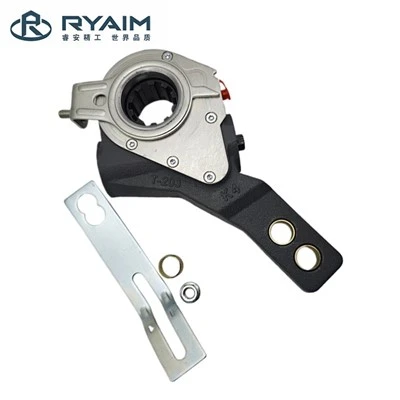
First, let’s ground this in what an ASA actually does, for anyone new to the role. Manual slack adjusters rely on a technician to manually adjust the gap between the brake shoe and drum as components wear. Automatic slack adjusters replace that human step: they use internal gears, springs, and a clutch mechanism to automatically compensate for lining wear, keeping that gap within the tight, industry-mandated range (typically 0.25 to 0.5 mm for most heavy-duty applications) every time the brakes are applied. The problem? If those internal gears stick, the clutch slips too early, or the adjustment range drifts over time, the ASA can leave brakes either too tight (causing overheating and premature component failure) or too loose (extending stopping distances to dangerous levels). That’s why our testing process is built to simulate every real-world condition an ASA will face: not just factory settings, but the vibration of cross-country highway travel, the constant heat and cold of regional routes, and the stop-and-go chaos of urban delivery.
Our testing starts with the most fundamental check: dimensional and visual inspection, but it’s far from the casual glance it sounds like. Before any functional testing begins, every ASA unit is measured with precision calipers, torque wrenches, and gear alignment gauges to confirm internal components match our design specifications. We check for burrs on gear teeth that could cause friction, ensure the clutch engagement point falls within our calibrated tolerance, and verify that the adjustment arm moves freely without binding. For example, a single misaligned gear tooth can throw off the entire adjustment sequence, leading to over-adjustment that forces brakes to stay slightly engaged even when the pedal is released. We flag any units here that don’t meet our standards, no exceptions—because fixing a defect on the factory floor is far cheaper and safer than recalling units from the field later.
Next, we move to functional bench testing, the core of our validation process. This is where we simulate the exact motion an ASA will see on a truck, but controlled in a lab setting. We mount each ASA to a test rig that replicates the torque input from the brake chamber, the linear motion of the brake rod, and the cyclic load of repeated braking. The rig cycles the ASA through 100,000 full adjustment sequences—equivalent to roughly two years of average fleet use—while we monitor two key metrics: adjustment accuracy and clutch reliability. Adjustment accuracy is measured with high-resolution linear sensors that track the gap between the brake pad and drum after each adjustment cycle. For a new ASA, we require that every adjustment lands within ±0.1 mm of the target gap; even a few units that miss this mark go back for rework, because we know that in service, those small errors add up over thousands of stops. Clutch reliability is tested by deliberately pushing the adjustment mechanism to its limit: we apply extreme torque to mimic a seized brake lining, then monitor to ensure the clutch slips rather than breaking, which would cause permanent damage to the ASA and leave the driver with no brakes at all. We also test for cold resistance by running bench cycles at -40°C, a temperature common in Northern Canada and Alaska, and heat resistance at 120°C, typical of a brake drum after hours of mountain descents. In these extreme conditions, we look for no change in adjustment accuracy, no oil leakage from internal seals, and no binding of moving parts—units that fail here are discarded, because a brake that can’t adjust in the cold of a winter morning is a safety hazard waiting to happen.
But bench testing only tells half the story. The real world is messier than a controlled lab, so we validate every design with on-vehicle field testing before a new ASA model is released to customers. For field testing, we partner with a mix of fleets: long-haul trucking companies running cross-country routes, regional delivery fleets making 100+ stops a day, and work trucks operating in construction and mining environments where components are subjected to constant vibration and dirt. We mount test ASAs to the rear axles of these vehicles, fitting each one with telemetry sensors that send real-time data on adjustment accuracy, brake temperature, and slack level back to our team. Over a six-month test period, we check units every 10,000 km to manually inspect for wear and cross-reference the sensor data. Last year, we ran a field test with 200 ASAs for a Midwest delivery fleet, and we noticed that three units in the stop-and-go urban routes were adjusting slightly more frequently than our bench test predicted. Digging into the data, we found that the constant, short brake cycles were wearing the internal clutch spring faster than expected, so we adjusted the spring tension in our design to extend service life by 15%. That’s the kind of real-world feedback you can’t get from a test rig, and it’s why our field testing process is non-negotiable—we don’t release a new ASA model until it’s proven to perform in environments our customers actually operate in.
Once an ASA is in service with a customer, we don’t stop testing there. We offer on-site performance testing support for our clients, because we know even the best ASAs need validation in their specific fleet conditions. Our team travels to fleet yards to conduct dynamic slack testing: we use a portable brake slack meter, a tool that measures the gap between the brake shoe and drum while the truck is on a lift, with the wheels rotated by hand. For a properly functioning ASA, the gap should be consistent across all wheels on the same axle, within the manufacturer’s specification. We also conduct brake stroke testing, which measures the distance the brake rod moves when the brakes are applied—excessive stroke (more than 30 mm for most heavy-duty units) is a clear sign the ASA isn’t adjusting correctly, indicating a worn clutch or binding gears. We work with our customers to train their maintenance teams on these simple, fast tests, so they can catch issues early during routine inspections, before they lead to brake failure. For example, a delivery fleet client of ours recently caught a faulty ASA during a routine brake stroke test, replacing it for less than $200 instead of facing a $5,000 tow and brake repair after a breakdown on a highway. That’s the value of proactive testing, and it’s exactly what we aim to deliver as a supplier: not just parts, but support to keep fleets safe.
A common question we get from customers is: how often should ASAs be tested? The short answer is at every brake service interval, or every 10,000 to 15,000 km for most fleets, plus after any brake job that replaces linings, drums, or the brake chamber. Even the best automatic slack adjusters can develop issues over time if they’re exposed to excessive dirt, vibration, or improper maintenance. We’ve seen ASAs that worked perfectly for three years fail suddenly because a technician used the wrong lubricant during a brake job, causing internal gears to bind. Our testing team has also found that fleets that skip routine ASA testing are 3x more likely to be cited for brake violations during DOT inspections, which can lead to fines and downtime. For that reason, we provide every customer with a free testing guide that walks through every step: how to access the ASA adjustment arm, how to use a slack meter, what readings are acceptable, and how to perform a quick function test by applying the brakes and releasing them to ensure the adjustment arm moves smoothly.
At the end of the day, testing automatic slack adjusters isn’t just a quality step for us—it’s a promise. When a fleet installs an ASA from our facility, they’re not getting a part that passes a set of factory checks; they’re getting a component that’s been validated in the lab, tested on the road, and supported by a team that understands the stakes of brake safety. We’ve built our business on this foundation, and we’re always looking for ways to refine our testing processes to meet the evolving needs of fleets around the world.

If you’re a fleet operator or maintenance manager looking to upgrade your ASA components, or if you have questions about testing your current automatic slack adjusters, we’d welcome the chance to connect and learn more about your needs.
Chinese Truck Series Manual Slack Adjuster References
Commercial Vehicle Safety Alliance. Brake System Inspection & Maintenance Guidelines. CVSA International, 2022.
National Highway Traffic Safety Administration. Heavy Vehicle Brake System Performance Requirements. NHTSA, 2021.
Fleet Maintenance Magazine. 2023 Automatic Slack Adjuster Performance Report. Endeavor Business Media, 2023.
Zhejiang Ryaim Auto Parts
As one of the most professional automatic slack adjuster manufacturers and suppliers in China, we’re featured by quality products and good service. Please feel free to wholesale custom made automatic slack adjuster from our factory. Contact us for more details.
Address: No.78, Yexiao Road, Yaojiang Town, Zhuji City, Zhejiang Province
E-mail: bd@zjryaim.com
WebSite: https://www.ryaimchina.com/
